Monday, June 17, 2013

Recreational vehicle

I never thought of myself as the RV type.

Today I got my hands on a borrowed three-man tent and mattress pad: basically a large ranch house with master bedroom furniture to go.

It all fits very nicely on a Vespa GTS. Heck, I'm not even going to feel the extra presence back there!
I've been offered the possibility of upgrading to a larger and more comfortable mattress pad.  Naturally I leapt at the chance.  I've barely begun and I'm getting comped!  I love getting comped!

My RV is rapidly headed to King-Size Komfort Land!!!  Well Gaaawwwwwllllllllllllleeeee!  Soon I'll be the envy of the Clampett Clan!

Saturday, June 15, 2013

Coasting

Lake St-Louis isn't the coast, it's the lakeshore. Yet, when I take the slow route to the office the view is still coastal.

Sharing it means taking a moment to stop, strolling a few feet to the shore and snapping a picture.

This particular view shows the point that's home to the Forest and Stream Club.

If you have eagle-eyes you'll spot a plane making its final approach to Trudeau airport.
My new bike is like a Siren enticing me to take the fast path where it can stretch its legs and zoom along. It's easy to neglect the benefits of coasting.

Monday, June 10, 2013

Distance challenges

As you may know if you've been hanging around here for a while, I began riding a motor scooter as a commuter.

It's been three seasons and three months since I rode my first commute. In that time, I have learned one heck of a lot about what it means to commute daily.

You can fill a thimble with what I know about long distance riding.

What's a long distance?

Well I have one long distance day-trip to my credit: 375 kilometers, or if you prefer, 233 miles. That's definitely a long distance ride, but it's about 70 miles shy of what I think many motorcycle tourists consider a decent day's ride.

I only think that, based on casual reading I've done from the comfort of my easy chair. I haven't researched it or attempted anything approaching semi-serious study.

I have a lot to learn. As is my lifelong habit, I plan to learn mostly by doing. Of course I am planning, you would have to be crazy not to plan.

My right wrist hurts. Right at the base of my thumb. It's some kind of strain injury. Whenever I develop a strain injury, I have to ask myself "what have I been doing since this pain started, that I wasn't doing before?". The answer is "I've ridden 15 thousand miles on a motorbike."

As you also know, things come to me slowly.

"Do you think that working the throttle is causing the strain that's causing the pain in my wrist?"

How will I feel after another 300 mile day, after other 300 mile days? It kind of makes me think.

What do motorcycle tourists do?

I was privileged to be at Bobskoot's place admiring his nu-2-him Beemer. He didn't seem to be too fussed that I sat on it. I didn't drop it, so it worked out allright. I noticed that Bob had some hardware on his throttle that I don't have. As soon as I saw it, I knew what it was. Did I mention that I read?

Today I had twenty minutes or so on my way to the office after a doctor's appointment.

I stopped at Moto Internationale, Montreal's largest BMW and Harley Davidson dealership. I was hoping for some instant gratification, and I wasn't disappointed.
For the uninitiated, the thingy on the left is a universal cruise control. The gizmo on the right relieves wrist strain. Both devices slip in one direction, grip in the opposite direction.

I tried the palm assist on the ride home. Interestingly, I felt relief in my wrist as soon as I started using it. Do you think that the throttle is causing my pain? Hmmmm...

Tomorrow there's rain in the forecast so I won't be testing the cruise control quite yet.

Wednesday, June 5, 2013

Birthplace of the Scootcommute

Few people know the birthplace of the ScootCommute.

That's because I was, until this very second, the only person to know the birthplace of the ScootCommute.

The ScootCommute was conceived, like so many other conceptions, in a hotel room.

To be more specific, in a very nice room at the Fairmont Palliser hotel in Calgary, on March 28, 2010.

I happened to be there on Monday and it struck me that I had returned to the scene of the crime.

So there you have it.

Sunday, June 2, 2013

High octane question?

Bob (no, not you) sometimes sends me questions.

Sometimes I'm not smart enough to grasp the problem that Bob tosses my way (other Bobs, please refrain from jumping in to provide testimony corroborating my occasional thickness).

A while back, Bob (no, not you) sent me a gem that I didn't immediately grasp the true meaning of.  So Bob (no, still not you) had to explain it to me patiently.

Well, it certainly is a puzzler in the fine tradition of NPR Car Talk, and I'm not nearly knowledgeable enough to shed any light on the matter.

So I turned to the world's most encyclopaedic source of scooter-related intelligence.  Yes, that's right, the Modern Vespa forum.  Here's a link to the post.

Here's Bob's question (I took some small editorial liberties to help the dimmer wits like yours truly in wrapping their brains around the nub of the problem).
Hmm... I see that the image makes Bob's question impossible to actually read.

Here it is clearly this time:
Once again I seek your help.

Perhaps you or one of your readers can answer a question that has long perplexed.

My new scooter requires high octane fuel - at least 91.

Back in the day it was simple - there was a dedicated premium pump somewhere at the station that pushed only the good stuff.

Now all the pumps are dial-a-matic with one hose and three or four grade selections.

Since the single big fat hose and filter hold a considerable volume of gasoline, and I assume that the gasoline in the hose is whatever the last customer selected (likely lower octane), how can I possibly get any of premium fuel into my tiny 6.0 L tank?

I strongly suspect that when I select and pay for premium, in most cases all I'm getting is regular, and treating the next cheapskate to a couple of gallons of my premium fuel for free.

A friend has a clever solution: He bought a 2 gallon can which he fills first, then takes home and empties into his car.

Alas I lack a second vehicle.

The best I've been able to come up with is that I lurk at the entrance of the station and follow immediately behind the person in the Mercedes, BMW or Ferrari.

Surely someone must have a better idea.
To be honest, this never crossed my mind. I guess I always assumed that you got what you paid for.

Is this a misplaced concern?

Is there some kind of check valve re-sucking system that purges the 'wrong' fuel from the hose?

Enquiring minds want to know.

If you, dear reader (that means you, Bob... yes you!) can shed some light, please chime in.

I'll wait for the smart answers to kick in on MV and then re-post the best of the lot here. If you're not the patient type, feel free to follow the link above and follow the action (if any) on Modern Vespa.

- - - - - TIME PASSED - - - - -

If you click the MV link you'll see that not much of any great merit happened, other than people suggesting that Bob shouldn't worry so much, and some folks pointing me in the direction of other threads (click here, and here) where, supposedly, the question had been asked, vigorously debated, and possibly answered.

Well it turns out that this one has the MV crowd pretty much stumped, making wild guesses, and stabbing in the dark. The consensus is "fugetaboutit" and "don't worry, be happy" and I find myself agreeing, yet being totally unsatisfied with the responses.

Otherwise very well-informed people are saying "there's hardly any gas in the hose, half a cup, max!".

Others say essentially the same thing, but estimates vary from half-a-cup (125 ml), to a cup (250 ml), to two cups (500 ml).

So I started Googling.

The smartest answer from the best source was this, from the Wall Street Journal:
Q: I ride a motorcycle with a typical three to four gallon gas tank. I ride where fuel stations are farther apart, so I fill up when the tank is still half full. The bike requires premium fuel, and doesn't run well on lower octanes. If the previous customer was pumping regular fuel, I assume the refueling hose is still full of regular fuel, perhaps a couple of gallons. This would mean I'm initially getting a mix instead of pure premium fuel. Is this a genuine concern, or does the system have a mechanism for evacuating the gas pump hose between uses?
-- Paul Kowacki,
Orange Mass.

A: It is a genuine concern, but one that motorcyclists tend to appreciate more than car drivers. According to the American Petroleum Institute the gas-pump hose typically retains about one third of a gallon of fuel. So when you pump a couple gallons of 93-octane premium after the previous customer pumped 87-octane regular, your fuel load would be diluted (not to mention overpriced).

This is more important to motorcyclists because bikes have smaller fuel tanks and a lower tolerance for low-octane gas compared with most cars. I have found that high-performance motorcycles designed to burn premium fuel run poorly on regular. They generally do not have the complex engine-control systems that allow cars to run on fuels of varying octane ratings.

I don't think diluting your premium fuel with a little regular will harm your motorcycle, especially if you always select the highest octane rating available. However, next time you're filling up you may want to get in line behind the driver with the highest-performance car in the station.
So if the WSJ is to be believed, and they are so far the most credible source, there is not half a cup, not a cup, or even two cups, but five cups (give or take - 1/3 of a gallon is 1.24919 liters, which we can round to 1.25 liters, which is five cups on the nose) of fuel left in the hose.

Just in the interest of trying independently to get to the nub of truth, let's say that the average gas station hose is 12 feet long.  According to Goodyear's web site, gasoline pump hoses are either 3/8" or 3/4" outside diameter hoses.  Let's take the worst case scenario, that's a 3/4" hose.  All 3/4" gasoline hoses have an inside diameter of 19.1mm (don't ask me why Goodyear's specs give the outside diameter in SAE and the inside diameter in metric).  The volume of gasoline in twelve feet of that type of hose is Pi (3.14159) times the square of the radius of the inside diameter of the hose (19.1mm divided by 2  = 9.55mm, squared = 91.2025mm) times the length of the hose (12ft, which in mm is 3657.6mm) equals  1,049,416.44 cubicmillimeters, or 1,049.41644 ml, or, rounded down is 1.05 liters, which is just a tad over four cups.

Based on the credible WSJ source, as somewhat corroborated by our mathematical, semi-scientific, guesstimated calculations, if we average the anecdotal journalistic number (5 cups) with the semi-scientific guesstimate (4 cups), we get 4 1/2 cups of questionable fuel in the hose.

In the case of the Vespa GTS 300 i.e., the tank capacity is 9.2 liters.  But even if you fill up only once the low fuel light comes on, the tank is not empty.  There are still about two liters of fuel in the tank.

Basically I'm buying 7 liters of fuel when I fill up.  That means that I'm getting 1.1 liters of questionable gas, and 5.9 liters of the good 91 octane gas that I need and want.  Assuming that the octane rating just dilutes like any other liquid, I'm not really getting a full tank of 91 octane, I'm really getting 90.37143 octane.

I think that's pretty well within spitting distance of the truth.

Based on everything I've heard and read about octane ratings and internal combustion engines, that's close enough to 91 octane that the Vespa engine won't suffer for the difference.

So I am declaring this one done, solved and one for the history books.  And I am going to join the ranks of the MVers who don't worry about the fudge in the gas that the local gas station is selling me.

Thanks Bob (no, not you, the other Bob), I thoroughly enjoyed digging to the bottom of this week's puzzler.

Friday, May 31, 2013

Project report: Installing a Stebel Nautilus Compact air horn

The stock horn on the Vespa GTS 300 i.e. emits a very polite "meep" when you press the button. Press it twice, and you get "meep-meep".

Until our recent trip to Italy, I couldn't understand why you would ever want to go "meep-meep" when you're in heavy downtown traffic doing 60 km/h and the oblivious cabby next to you suddenly moves to obliterate you. It's even more of a mystery when you consider that the Vespa GTS can cruise all day long on the autoroute at 118 km/h.

Italy changed my opinion of the engineers at Piaggio.

In Italy, the stock horn fits right in. In Italy you use the horn politely on blind corners; or just before cutting another vehicle off with brio; or when you coast down a street in Sorrento (here we call them sidewalks) and want to announce your arrival politely to your friends seated at tables in the street enjoying pizza and drinking Chianti; or when you want to join ten or fifteen other drivers who are honking to 'help' clear congested traffic. Those uses account for 99.99% of all Italian horn use. And "meep-meep" or sometimes "meeeeeeeeeeeeep!!!", is just the right tone. You see, in Italy the people in the cars KNOW they are sharing the road with motorbikes, and expect to be cut off with brio.

That won't do here. Here when you need your horn, you have to get the attention of Cadillac Escalades in the hands of well-meaning, well-heeled, but distracted, assassins. You want to press the button and go "BBBLLLLAAAAAAAAAAAAAH!".

Fortunately the Italians invented just the thing for North American needs. It's name is the Stebel Compact Nautilus, and it's an air horn for motorbikes. It goes "BBBLLLLAAAAAAAAAAAAAH!".

The trick nowadays is finding one of these gems. The manufacturer seems to have discontinued them (likely too little demand in Italy; too few buyers here). Fortunately I have one.

I extracted it from my Vespa LX 150 and here's how you install it in a Vespa GTS.

This is not especially difficult.

First find a Stebel Compact Nautilus on Ebay and snatch it up.

Once you have it, the bit that's tricky, is getting the right kind of juice to the horn.

The stock horn gets all the power it needs straight from the horn button. The Stebel horn is a serious horn. It needs power straight from the battery. When in operation it draws close to 20 amps. It needs its own fuse (I use a 25A fuse).

Here's wiring diagram that I made for the installation. If you click on it you'll get a larger more user-friendly image.

The first thing you need to do to get the installation going is to open up the bike.

First remove the Piaggio badge.
Next remove the single screw that secures the horncast.

Slide the horncast up, and off the bike. Next remove the two kneepad panels.

That exposes the screws retaining the legshield and glove box. There are two screws under the horncast, two screws at the base of each side of the legshield on the rider's side side, two screws behind each of the kneepads. Finally, there is another screw inside the glovebox. Once all the screws are removed, and once you remove the cap from the radiator fill tube,  it's possible to wiggle the legshield free. Here's a link to an excellent video produced by Mic Bergsma that will make this all crystal clear.
Now disconnect and remove the stock Vespa horn. The wires that are connected to the stock horn are then reconnected to the 85 and 86 terminals of the automotive relay. The automotive relay can be zip tied to the horn assembly.

Now run the negative lead from the terminal strip to the negative Stebel horn terminal located on the base of the horn. Run the positive 25A fused lead from the terminal strip to the 30 terminal of the relay. Now run a positive lead from the 87 terminal of the relay to the positive terminal of the Stebel horn.

Here's video that shows what the terminal strip I made looks like. It's handy because it makes it easy to install more circuits (like heated grips, eventually).

Working from the rider side of the legshield, wiggle the horn into position so that the horn is essentially vertical with the mouth of the trumpet aligned with the horncast opening. The fit is extremely snug. I was not able to use a zip tie on it. Once the legshield is buttoned back up, the horn will be stuck there and will not move.
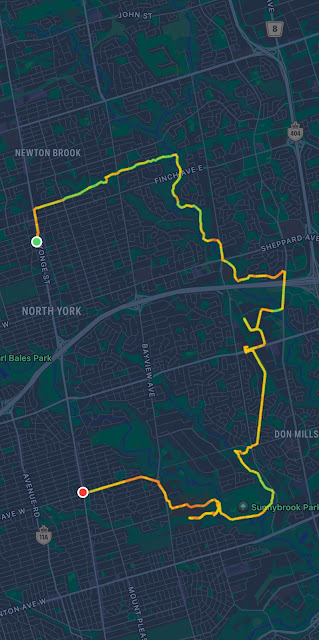
Here are some photos showing the horn installed and that relay zip tied in place.
Before buttoning the Vespa back up, it's best to test the installation to make sure that the horn is working well. Here's a video that follows the negative and positive electrical leads from the battery, up through the interior of the legshield, over to the terminal strip, and then shows that horn test.

Now that the horn has passed its test, and the ringing is subsiding in your ear, it's time to put the bike back together.

There's a trick. You knew that there had to be a trick, right?

It took me some cursing and Googling, and I'll spare you the pain.

Piaggio has a fiendish streak in their industrial design, usually involving things that lock, like the glovebox, for instance.

It turns out that wiggling the glovebox into place and making sure that the mechanical link that unlocks the glovebox when you push on the ignition switch assembly, is impossible, unless you get an elastic band, hook it on the base of the dogleg lever that actuates the glovebox lock release, pass the elastic to the front of the legshield and hook it onto something (anything will do), all to make sure that the blasted little free-floating, four-flushing, dog-leg lever stays put in the retracted position.

Now you can go ahead and wiggle the legshield back into position, and button everything back up.

Simple (OK I cursed a little). But now I have my loud horn back. Yesssssss! Feeling safer already, and it's already saved my bacon on a couple of occasions.

Friday, May 24, 2013

Farkle, meaning

Main Entry: far·kle
Pronunciation: \ˈfär-kəl\
Function: verb
Inflected Form(s): far·kled; far·kling \-k(É™-)liÅ‹\
Etymology: Moto English, conflation of function and sparkle
Date: 20th century
transitive verb, to add after-market functionality to a powered two-wheeler, especially chrome-plated accessories
synonyms: splurge
— far·kly \-k(É™-)lÄ“\ adjective
noun, a device extending the function of a powered two wheeler
Vespas may be the ultimate urban vehicle.  They are compact, comfortable, nimble, powerful, rolling works of automotive art.

Vespas are also wonderful beasts of burden.  A stock Vespa offers spacious underseat storage and a glove box in the legshield, both of which lock securely, and a bag hook on the legshield.  There is also the passenger seat. With a few straps, bungees or cords you can carry some surprising stuff on the passenger seat.

Most Vespa owners augment this already impressive capacity by adding a rear rack, a topcase and sometimes a front rack.

It's the carrying capacity of scooters, and Vespas in particular, that makes them superbly suited as a commuting vehicle.

But can the ultimate commuter bike also tour?

The Vespa's achilles heel as far as touring is concerned has nothing to do with its small wheels, and  everything to do with its small fuel tank.

It's a more or less open secret that I'm gearing up for a major touring challenge.  It will be a significant challenge for me.  On the other hand, I have every reason to believe that my Vespa GTS 300 i.e. Super is more than capable of carrying me there, and back.

The trick to touring on a Vespa is to use other Vespa strengths to compensate for the Vespa's main weakness.

Today I received a long awaited farkle from Didge at Classic Racks in the UK.  Didge is legendary among Vespa cognoscenti as the inventor, manufacturer and purveyor of the versatile footrack.
No, a footrack is not a rack you wear on your foot, nor is it a rack on which to rest, or store your foot.

It's a sturdy metal rack that turns the Vespa's footwell into a superb place to carry gear that would be challenging to carry elsewhere.  It's also the perfect place to carry a small jerry can of gasoline.
True to Vespa form, Didge's footrack serves its utilitarian purpose, and does it in style.  Installing the rack took a screwdriver and all of fifteen minutes.
Next step: go to Canadian Tire and pick up a suitable gasoline container.
The copyright in all text and photographs, except as noted, belongs to David Masse.